Thursday, March 14, 2024

6 Best Soft Food for Dogs with No Teeth


Dogs are more than just pets; they are members of our families. As such, we want to ensure that they are healthy and happy. However, some dogs may face challenges that require us to make adjustments to their diets. Dogs with no teeth or those that have lost their teeth due to age or disease may struggle to eat hard kibble or bones. This is where soft food comes in.

Soft food for dogs with no teeth is specially formulated to be easy to digest and gentle on the gums. It comes in a variety of flavors and textures, making it easy to find something that your furry friend will love. However, it’s important to pay attention to the ingredients in soft dog food to ensure that it meets your dog’s nutritional needs.

When purchasing soft food for dogs with no teeth, it’s essential to look for a product that contains high-quality protein sources, such as chicken or beef. You should also consider the ingredients that your dog may be allergic to, such as grains or certain types of meat. Additionally, it’s crucial to choose a product that is easy to digest and doesn’t contain any additives or preservatives that could cause stomach upset.

At the end of the day, soft food for dogs with no teeth is an excellent option for pet owners who want to ensure that their furry friends are getting the nutrients they need without causing them discomfort. In this article, we’ll take a closer look at the best soft food options for dogs with no teeth and provide you with the information you need to make an informed purchase.

Best Soft Food for Dogs with No Teeth

We understand that feeding a dog with no teeth can be a challenging task. Dogs require a balanced diet to maintain their health and energy levels, but it can be difficult to find food that is both soft and nutritious. That’s why we have researched and tested various soft food options to create a list of the best soft food for dogs with no teeth. Our list includes options that are not only easy to chew and digest but also provide essential nutrients to keep your furry friend healthy and happy.

#1 – JustFoodForDogs Pantry Fresh Wet Dog Food, Complete Meal or Dog Food Topper, Chicken & White Rice Human Grade Dog Food Recipe – 12.5 oz (Pack of 12)

If you’re looking for soft food for your dog with no teeth, JustFoodForDogs Pantry Fresh Wet Dog Food is a great option.

Pros

  • Made with fresh whole foods that are gently cooked for optimal nutrient absorption
  • 40% more digestible than kibble, making it easier for dogs with no teeth to eat
  • Free from preservatives and can be stored unopened for up to two years, making it perfect for traveling

Cons

  • More expensive than traditional canned dog food
  • Some dogs may not like the taste or texture
  • Contains rice, which may not be suitable for all dogs

This soft food is 100% human grade, which means it’s made with high-quality ingredients that are safe and healthy for your dog. It’s also shelf-stable, which means you don’t have to worry about it spoiling or going bad if you don’t use it right away.

One of the biggest benefits of this soft food is that it’s highly digestible, which means it’s easier for dogs with no teeth to eat and digest. It’s also a complete meal, so you don’t have to worry about supplementing your dog’s diet with additional nutrients.

While this soft food is more expensive than traditional canned dog food, it’s also much healthier and more nutritious. It’s a great option for pet parents who want to provide their dogs with the best possible nutrition.

Overall, if you’re looking for soft food for your dog with no teeth, JustFoodForDogs Pantry Fresh Wet Dog Food is a great option. It’s made with high-quality ingredients, is highly digestible, and is shelf-stable, making it perfect for traveling.

#2 – Blue Buffalo Delectables Grain Free Natural Wet Dog Food Topper Variety Pack

If you’re looking for a tasty meal topper or healthy snack for your dog, the Blue Buffalo Delectables Grain Free Natural Wet Dog Food Topper Variety Pack is a great option.

Pros

  • The savory gravy combined with tender cuts of real beef or chicken and garden veggies make for an irresistible flavor that dogs love.
  • These pouches are easy to open and perfectly portioned, making serving BLUE Delectables extra convenient.
  • Blue Buffalo only uses the finest natural ingredients, with no poultry by-product meals, no corn, wheat, or soy, and no artificial flavors or preservatives.

Cons

  • The packages are on the smaller side, which may not be ideal for larger dogs or frequent use.
  • The price point may be higher than other wet dog food toppers on the market.
  • Some reviewers have mentioned that the packaging can be messy and difficult to handle.

If you’re looking for a tasty and convenient wet dog food topper or healthy snack for your dog, we recommend giving the Blue Buffalo Delectables Grain Free Natural Wet Dog Food Topper Variety Pack a try. The savory gravy, high-quality ingredients, and easy-to-use pouches make it a great addition to your dog’s mealtime routine. However, keep in mind that the small package size and higher price point may not be ideal for all pet owners.

#3 – Stella & Chewy’s Wild Red Wet Dog Food Variety Pack Stews High Protein Recipes, 10 Ounce (Pack of 3) Variety Pack (1 Can of Each Recipe) 10 Ounce (Pack of 3)

If you’re looking for a high-quality soft food for your dog with no teeth, Stella & Chewy’s Wild Red Wet Dog Food Variety Pack Stews is a great option.

Pros

  • This wet food is packed with responsibly sourced, animal-based protein.
  • The variety pack offers three different flavors to choose from.
  • The recipe is fortified with vitamins, minerals, and amino acids to support your dog’s whole body health.

Cons

  • The price may be a bit steep for some dog owners.
  • The consistency of the stew may be too watery for some dogs.
  • Some reviewers have noted that the cans may arrive dented or damaged.

Stella & Chewy’s Wild Red Wet Dog Food Variety Pack Stews is a grain-free soft food that’s easy for dogs of all life stages to digest. The recipe features tender shredded meats in a savory broth that your dog is sure to love, and the variety pack allows you to try all three flavors to see which one your dog prefers.

In addition to being delicious, this soft food is also great for your dog’s health. It’s fortified with vitamins, minerals, and amino acids to support your dog’s whole body health, and it contains pumpkin and natural fiber for digestive health and veggies for an antioxidant boost.

While some dog owners may find the price to be a bit steep, the quality of the ingredients and the benefits to your dog’s health make it well worth the investment. Keep in mind that the consistency of the stew may be too watery for some dogs, and some reviewers have noted that the cans may arrive dented or damaged.

Overall, if you’re looking for a high-quality soft food for your dog with no teeth, Stella & Chewy’s Wild Red Wet Dog Food Variety Pack Stews is a great option to consider.

#4 – BIXBI Rawbble Freeze Dried Dog Food, Pork Recipe, 26 Oz

If you’re looking for a soft food option for your dog with no teeth, BIXBI Rawbble Freeze Dried Dog Food is worth considering.

Pros

  • Made with 97% meat and organs, providing a healthy source of protein for your pup.
  • Freeze-dried technology locks in essential nutrients, making it a convenient and portable option.
  • No artificial preservatives, colors, or flavors, and no added hormones or antibiotics.

Cons

  • Some reviewers noted that the food can be hard to crumble, making it difficult to use as a food topper.
  • It may be more expensive than other soft food options.
  • While it’s advertised as a grain-free option, some reviewers noted the presence of rice flour in the ingredient list.

BIXBI Rawbble Freeze Dried Dog Food is a limited ingredient soft food option made with high-quality, human-grade pork. It’s a grain-free and gluten-free option with no added hormones or antibiotics, making it a healthier option for your furry friend.

The freeze-dried technology used to make this food locks in essential nutrients, making it a convenient and portable option for pet owners on-the-go. However, some reviewers noted that the food can be hard to crumble, which may make it difficult to use as a food topper.

While it may be more expensive than other soft food options, BIXBI Rawbble Freeze Dried Dog Food is a great choice for pet owners looking for a high-quality, limited ingredient soft food option for their dogs with no teeth.

#5 – The Honest Kitchen Dehydrated Whole Grain Chicken Dog Food

If you’re looking for a soft food option that’s made with human-grade ingredients, The Honest Kitchen Dehydrated Whole Grain Chicken Dog Food could be a great choice for your furry friend.

Pros

  • Made with free-range chicken and organic grains for maximum nutrition and digestion
  • Suitable for both puppies and adult dogs of all breeds and sizes
  • Easy to prepare – just add warm water and serve alone or as a topper to dry food

Cons

  • Some dogs may not like the taste or texture
  • Can be more expensive than traditional canned food options
  • Some owners may find the preparation process time-consuming

This whole grain recipe is made with uncompromising quality control standards using real, whole food ingredients, like free-range chicken, that are gently dehydrated to maintain nutrients and taste. To meet their 100% human-grade standard, The Honest Kitchen uses the same whole food ingredients you’d recognize in your own kitchen and makes this food in a human food facility.

One of the biggest pros of this food is that it’s made with high-quality ingredients that are easy to digest. It’s also suitable for both puppies and adult dogs of all breeds and sizes, making it a versatile option for many pet owners. Additionally, the easy-to-prepare formula makes it a convenient choice for busy pet parents.

However, some dogs may not like the taste or texture of this food, and it can be more expensive than traditional canned food options. Additionally, some owners may find the preparation process time-consuming, as it requires adding warm water and waiting a few minutes before serving.

Overall, if you’re looking for a soft food option that’s made with high-quality ingredients, The Honest Kitchen Dehydrated Whole Grain Chicken Dog Food could be a great choice for your pup.

#6 – Crafted by Humans Loved by Dogs Wet Dog Food Pouch

We highly recommend the Crafted by Humans Loved by Dogs Wet Dog Food Pouch for pet owners looking for a convenient and healthy soft food option for their dogs with no teeth.

Pros

  • Made with all-natural, human-grade ingredients
  • Gluten-free, wheat-free, and grain-free options available
  • Can be used as a supplemental meal, mixer, or treat

Cons

  • Pricier than some other wet food options
  • Some customers reported issues with the packaging being difficult to open
  • One customer reported their puppy becoming ill after trying the chicken flavor

Crafted by Humans Loved by Dogs Wet Dog Food Pouch is a great option for pet owners who want to give their furry friends a healthy, human-grade meal without the hassle of cooking and preparing it themselves. The pouches come in a variety of flavors, including turkey, pork, salmon, and beef, and are easy to serve at home or on the go.

One of the biggest pros of this product is the quality of the ingredients. All of the ingredients are certified human-grade, and the meats used are USDA-certified. The wet food is also gluten-free, wheat-free, and grain-free, making it a great option for dogs with sensitive stomachs or allergies.

Another great feature of this product is its versatility. The wet food can be used as a supplemental meal, combined with dry food as a mixer, or used as a treat. This makes it a great option for picky eaters or older dogs who may have trouble chewing harder foods.

While the Crafted by Humans Loved by Dogs Wet Dog Food Pouch is a bit pricier than some other wet food options, many customers find that the quality of the ingredients and convenience of the packaging make it worth the cost. However, some customers did report issues with the packaging being difficult to open.

One customer also reported their puppy becoming ill after trying the chicken flavor. While this is just one isolated incident, it’s important to keep in mind that every dog is different and may have different dietary needs and sensitivities.

Overall, we believe that the Crafted by Humans Loved by Dogs Wet Dog Food Pouch is a great option for pet owners looking for a convenient and healthy soft food option for their dogs with no teeth.

Soft Food for Dogs with No Teeth Buying Guide

When it comes to choosing the best soft food for dogs with no teeth, there are a few key features to look for. Here are some things to consider:

Texture

The texture of the food is one of the most important things to consider when choosing a soft food for your dog. Look for foods that are easy to chew and swallow, such as pates, stews, and purees. Avoid foods that are too chunky or have large pieces that could be difficult for your dog to manage.

Ingredients

It’s important to choose a soft food that is made with high-quality ingredients. Look for foods that are made with real meat, vegetables, and fruits, and avoid foods that contain fillers, by-products, or artificial preservatives.

Nutritional Content

When choosing a soft food for your dog, it’s important to consider the nutritional content. Look for foods that are balanced and complete, with a good balance of protein, fat, and carbohydrates. You may also want to consider foods that are fortified with vitamins and minerals to ensure that your dog is getting all the nutrients they need.

Flavor

Dogs with no teeth can still enjoy the taste of their food, so it’s important to choose a soft food that your dog will enjoy. Look for foods that are made with real meat and other flavorful ingredients, and avoid foods that are bland or unappetizing.

Packaging

Finally, consider the packaging of the soft food. Look for foods that come in easy-to-open containers, such as cans or pouches, and avoid foods that require a lot of effort to open or store. You may also want to consider the size of the packaging, especially if you have a small dog.


from Tuuka's Tails https://tuukastails.com/6-best-soft-food-for-dogs-with-no-teeth/
via Tuuka's Tails

Double Doodle Dog: All About the Labradoodle & Goldendoodle Crossbreed


The Double Doodle is a glorious crossbreed containing a mixture of two Doodle mixes; the Labradoodle (Labrador-Poodle mix) and Goldendoodle (Golden Retriever-Poodle mix). They have the classic gorgeous curls of the Poodle with the lovely loyal, playful traits of the Labrador and Golden Retriever. If you’re thinking about getting one, keep reading for all of the key facts you need to know!

Just a head’s up, this post contains affiliate links where we recommend products. We earn a commission at no extra cost to you if you buy anything through these links.

Double Doodle fast facts

Average Weight Toy: up to 10-25 lbs (4.5-11kg), Mini: 25-24 lbs (11-20 kg), Standard: 50-100 lbs (23-45 kgs) 
Average Height Toy: up to 14 inches (36 cm), Mini: 14-20 inches (36-51 cm), Standard 20-29 inches (51-74 cm)
Hypoallergenic? Often but not always
Coat Thick, medium-long, curly double coat
Shedding Low-moderate shedding
Grooming High maintenance
Barking Not especially vocal 
Good with kids? Yes
Good with cats? Yes with socialization 
Good with other dogs? Yes
Tolerates being alone For short periods
Tolerates apartment life Smaller variations yes
Training Highly trainable 
People pleaser? Yes
Exercise Needs 40-60 minutes per day
Health Concerns Heart problems, eye problems, hip and elbow dysplasia, allergies.
Life Span 10 – 15 years
Average cost $1500-$3000+

History & Origin of the Double Doodle

Most mixed breeds are too new to have a history – let alone a double mixed breed! They are a very recent American creation, combining two crossbreeds for the ultimate designer dog! Let’s explore the history of its parent breeds and crossbreeds to better understand them.

Labradoodle 

The Labradoodle was created in Australia in the 1980s by dog breeder Wally Conron. His goal was to develop an assistance dog with a hypoallergenic coat for disabled people with allergies.

Goldendoodle

The first Goldendoodle is believed to have been bred by author and great-granddaughter of Charles Dickens, Monica Dickens, in 1969 in England. However, it wasn’t until the 1990s that breeders began intentionally breeding Goldendoodles, due to the success and popularity of the Labradoodle in the decade prior. 

Labrador 

The Labrador’s roots lie in the island of Newfoundland, Canada, where they were initially known as Lesser Newfoundlands. They were originally bred by fishermen and settlers in the early 19th century from the ancient St John’s water dog to assist with retrieving fishing nets and hauling loads. Their name comes from the Labrador Sea, the region where they come from.

Labradors arrived in the USA in the early 20th century and were officially recognized by the American Kennel Club in 1917. They consistently rank as the most popular dog breed in the United States, the United Kingdom, and across the Western world, both as beloved pets and seeing-eye dogs for the visually impaired. 

Yellow Labrador Retriever

Golden Retriever

The Golden Retriever has a rich history dating back to the mid-19th century in Scotland. They were initially developed by crossing the now-extinct Yellow Retriever with the Tweed Water Spaniel and the Bloodhound. They were refined over several generations to become the ultimate family dogs that we know today. 

Golden Retrievers gained popularity in the United States during the early 20th century, being recognized by the AKC in 1925, and have since become one of the most beloved and popular dog breeds worldwide. 

Looking for fun facts about Golden Retrievers? Today, we're going to check out some things about America's 3rd favorite dog that you probably didn't know!

Poodle

Originally, Poodles were bred to be water-hunting dogs, but thanks to their unique beauty, you can spot them in modern fashion photography and European art dating back to the 15th century. They were first bred in Germany, with their name being a straight-up translation of the German word “Pudel,” which means “to splash water.” These guys have family ties to various European water dogs and are kin to other modern European water breeds.

There are three Poodle sizes: Toy, Miniature, and Standard. The American Kennel Club gave them the nod of approval back in 1887, and they’re still one of the world’s most popular dog breeds today, ranking second highest in canine intelligence and getting mixed with tens of other breeds because of their gorgeous hypoallergenic curls.

Poodle

Physical characteristics of the Double Doodle 

All about the physical traits of the crossbreed.

Size & weight

The size of a Double Doodle depends on the size of the Poodle used to breed them. Standard Double Doodles typically stand between 21 to 29 inches (53 to 74 cm) tall and weigh around 50 to 100 pounds (23 to 45 kg). 

Miniature Double Doodles measure approximately 17 to 21 inches (43 to 53 cm) in height and weigh between 35 to 60 pounds (16 to 27 kg). Toy Double Doodles are the smallest, with a height of about 14 to 17 inches (36 to 43 cm) and a weight ranging from 25 to 45 pounds (11 to 20 kg). 

Breeding & puppyhood

Breeding Double Doodles doesn’t come with any significant issues, they are not prone to dystocia or difficult birth, but we always recommend full veterinary support, help, and advice throughout the breeding of puppies, whatever the breed. 

Litter sizes for Double Doodles can vary depending on the size of the parent dogs, but they often range from 6 to 10 puppies per litter. In terms of development, they typically reach their adult size by around 12 to 18 months of age. Sexual maturity is usually attained between 6 to 12 months, while mental maturity can continue to develop up to 2 years or more.

Appearance

Double Doodles have curly coats that come in several colors. They have broad faces and floppy ears, expressive, almond-shaped eyes, and a sturdy, well-proportioned body with long legs and tails.

a cute Double Doodle dog

Color

The coat colors of Double Doodles are extremely diverse due to their parent breeds. However, cream, gold, apricot, chocolate, black, and parti-color are among the most common colors in the crossbreed. They can also have spots, patches, or other patterns, depending on their genetic heritage.

Coat-type

Double Doodles typically have a thick, dense, soft single coat with no undercoat that can be medium to long and wavy or curly. They’re typically low shedders and require a lot of grooming to maintain good condition.

Are Double Doodles hypoallergenic?

Most Doodle breeds are hypoallergenic, but due to the varied mixture of genetics, whether or not a Double Doodle will be hypoallergenic depends on how dominant their Poodle genes are.

Double Doodle personality

Double Doodles have a delightful blend of personality traits. They are known for their friendly and social nature and they are typically affectionate, eager to please, and thrive on human interaction. Their intelligence makes them quick learners, and they often excel in obedience training and learning new tricks.

Double Doodles are usually playful and active without being hyperactive. They enjoy outdoor activities, games, and exercise, making them great partners for active families. Their friendly disposition extends to children, other dogs, and even strangers.

Additionally, their loyalty and protective instincts make them excellent watchdogs, as they can be attentive to their family’s well-being without displaying aggression or excessive territorial behavior. Overall, Double Doodles tend to be affectionate, sociable, and well-rounded companions.

Double Doodle

Are Double Doodles good family dogs?

Double Doodles are the ideal family dogs. They are super friendly and loving towards their families, and patient with little children. Their intelligence and trainability also contribute to their suitability as family pets, as they can adapt well to various household dynamics and lifestyles.

Are Double Doodles good with other dogs?

Yes, Double Doodles are typically good with other dogs. They tend to be sociable and friendly, which can help them get along well with other canine companions. However, as with any dog, proper socialization and supervision are essential to ensure positive interactions with other dogs.

Are Double Doodles protective? 

Double Doodles, like all dogs, are very protective of their homes and loved ones, While they may be alert to potential threats, they remain friendly and non-aggressive unless absolutely necessary for self-defense or the protection of their loved ones.

Are Double Doodles aggressive?

Double Doodles are not typically aggressive dogs. However, individual behavior can vary, and early socialization and training are essential to ensure a well-behaved and non-aggressive Double Doodle.

Are Double Doodles easy to train?

Training Double Doodles is a breeze thanks to their smarts and desire to please. Use that fun-loving streak to your advantage with lots of positive reinforcement, and keep training sessions short to keep boredom at bay. 

Begin with the basics and never punish your pup for bad behavior, but rather redirect and correct them. Ideally, you’ll kick off your puppy’s training around 12 weeks old and aim for 5-15 minute sessions once or twice a week. Remain consistent and be patient with your pup as they learn!

double doodle outside

Do Double Doodles get separation anxiety?

Separation anxiety is very distressing for dogs and can cause destructive behaviors like howling and going potty indoors, so it’s important to make sure your pup is well looked after. Any dog can get separation anxiety, but Double Doodles they are at a higher risk because they’re such social and intelligent dogs. 

Pent-up energy from not getting enough exercise, boredom from lack of play, and loneliness from spending too much time alone can all increase the likelihood of separation anxiety in dogs. So, to reduce the risk, make sure your pup’s needs are met and practice separation training early on. 

You can do this by building their independence gradually through alone time and creating positive associations and rewards. Stay calm and avoid reacting negatively to any destructive behaviors. You can also try out some anti-anxiety products to aid your training. 

Do Double Doodles get bored easily?

Double Doodles are bright and active dogs thanks to their parent breeds, so they can get bored a little bit more easily than some other dogs. Over time, chronic boredom can lead to destructive behaviors. They need mentally stimulating play through challenging games like hide and seek and interactive toys like treat dispensers, puzzles, and snuffle mats, as well as plenty of company and fun walks to keep boredom at bay. 

Do Double Doodles drool a lot?

Double Doodles aren’t known to be heavy droolers, but any dog can drool when they’re around something that smells delicious! 

Are Double Doodles noisy?

Double Doodles are not known to be noisy dogs. They may bark and growl to communicate or alert their owners to something, but they aren’t known for being excessively loud.

A brief look at the basic needs of Double Doodle for budding owners. 

Diet

Ensure your dog’s well-being with a balanced diet, focusing on nutritionally complete dog food packed with essential vitamins, minerals, healthy fats, carbs, and lean proteins. Opt for quality kibbles or wet dog foods made from real ingredients, avoiding cheap fillers and chemicals.

Choose dog food tailored to your dog’s size and life stage, as their nutritional needs vary, and larger breeds may require extra protein and omegas for strong bones and muscles.

We recommend: Nom Nom Fresh Dog Food

Nom Nom Fresh Food for Dogs (Pork Potluck)

How much should a Double Doodle eat?

Standard Double Doodles require 2-3 cups of food daily, split into two meals. Miniatures usually need 1 cup, while Toys typically require ½ cup.

For puppies, feed them 20% of their weight per day, divided into 3-4 small meals, and adjust seniors’ calorie intake as they age to reduce pressure on the joints and avoid weight gain.

Exercise 

Double Doodles need 40-60 minutes of daily exercise, depending on their size. For Double Doodle puppies, aim for about 5 minutes of exercise per month of age daily, while seniors should reduce activity to protect their joints as they age.

They enjoy walking, running, and swimming, thanks to their water-baby genes. These dogs thrive outdoors and relish camping trips and day trips out. If you can take them to a dog-friendly lake or the beach, they’ll have a blast! 

Grooming 

Care must be taken to maintain the Double Doodle’s coat. Due to their tendency to tangle and trap dirt, Double Doodles require regular grooming to stay clean and avoid matting, a common concern for Doodle breeds, which can cause discomfort and skin issues.

To maintain their coat, owners need to brush them every 2-3 days using a good slicker brush and bathe them monthly with a natural dog shampoo designed for curly coats. Regular haircuts every couple of months are also necessary to prevent tangles and mats from developing.

You can also consider a grooming kit like the Neakasa Neabot S1 Pro (hint: it’s usually cheaper on their own website versus other retailers, so check there first).

Are Double Doodles healthy?

Double Doodles have an average lifespan of 10-15 years. They are generally healthy dogs, but all breeds and crossbreeds are naturally predisposed to having certain health conditions. When buying a puppy from a breeder, you should ask them for health documentation that covers breed-specific genetic conditions. They are commonly affected by the following things.

Hip & elbow dysplasia 

Hip & elbow dysplasia is a prevalent genetic ailment among dogs, resulting in abnormal growth of the joints. It eventually leads to arthritis and requires surgery to correct the joint, but that’s not usually necessary unless severe.

Vets diagnose the condition through a basic physical examination and x-ray. Mild cases can often be managed with lifestyle adjustments, non-surgical therapies, hip & joint supplements, and pain relief medications, and shouldn’t affect the length or quality of a dog’s life. 

Symptoms of hip & elbow dysplasia in dogs include:

  • Limping or bunny hopping
  • Whining or showing signs of pain/discomfort 
  • Loss of muscle mass around the hips
  • Low energy and irritability 
  • Limited mobility 
  • Inability to get comfortable
  • Licking the affected joints
Hemp & Hips Plus CBD

Best CBD Oil Supplement for Dogs

Vet Naturals Hemp & Hips quickly delivers a CBD richer in joint-supporting cannabinoids and terpenes, easing joint pain and anxiety in as little as 10 minutes. The 100% naturally organic blend is formulated by vets and Made in the USA.

Hemp & Hips Plus CBD

Bloat (Gastric torsion)

Bloat or gastric torsion in dogs is when the stomach fills with gas and it’s significantly more common in large, deep chested breeds like the Standard-sized Double Doodle. It’s caused by the rapid accumulation of gas in the stomach, often by eating too fast. 

It is considered a medical emergency because it can twist the gut in a way that cuts off its blood supply, and it requires immediate treatment. It can also make the spleen twist and lose circulation, and block vital veins in the back that carry blood to the heart.

Any dogs suspected of having bloat must be taken to the emergency vet hospital as soon as possible. They will need to have their stomach pumped and receive IV fluid treatment, antibiotics, painkillers, and surgery.

Signs of bloat in dogs include:

  • A hard, swollen belly
  • Retching
  • Drooling
  • Abdomen pain
  • General distress

Arthritis 

Arthritis is a common joint condition characterized by inflammation, pain, and reduced mobility, often caused by wear and tear, aging, or underlying health issues. It’s especially prevalent in big dogs like Standard Double Doodles because their joints have extra weight and pressure on them.

There is no cure but there are several ways to manage it and relieve the symptoms from non-surgical therapies and lifestyle changes to herbal pain remedies and pain medications. 

Signs of arthritis in dogs include:

  • Limping or favoring one leg
  • Stiffness, especially after rest
  • Difficulty getting up or lying down
  • Reluctance to climb stairs or jump
  • Noticeable decrease in activity level
  • Swelling or warmth in the affected joints
  • Yelping or whimpering when touched in specific areas or making big movements
  • Irritability or withdrawal

Dilated Cardiomyopathy (DCM)

Double Doodles can be prone to Dilated Cardiomyopathy, also known as DCM. It is typically a genetic disease and causes weakened contractions and poor pumping ability in the heart, eventually leading to heart failure. 

There is currently no cure and usually, it can’t be reversed, but there are ways to manage the symptoms and prolong life after diagnosis. DCM happens in two phases; the occult phase, in which there are no symptoms, and then the overt phase, when clinical signs start to show. Dogs can live anywhere from months to years with the condition.

Signs of DCM in dogs include:

  • Low energy 
  • Fainting or collapsing
  • Coughing or gagging
  • Trouble breathing
  • Reduced appetite 
  • Inability to exercise
  • Weight changes
  • Swelling in the stomach

Allergies

Double Doodles are also prone to allergies because of their sensitive Poodle genetics, which can include food, skin, and environmental allergies. Common food allergies in dogs include beef, chicken, dairy, wheat, and soy.

Food allergies can cause: 

  • Smelliness 
  • Dull coat
  • Lethargy 
  • Stomach upsets

Topical allergies include harsh chemicals in shampoos and conditioners and can cause:

  • Hives
  • Hair loss
  • Skin irritation
  • Itching 
  • Redness

Common environmental allergies include pollen, dust, and home cleaning products and can cause: 

  • Red or irritated eyes
  • Sneezing
  • Coughing
  • Runny nose

If you think your dog is allergic to something in their diet, you should talk to your vet about doing an elimination diet to help you find and cut out the cause of their symptoms or switch to hypoallergenic food. Stick to topical products with natural, gentle formulas, and try antihistamine medication for environmental allergies if the cause can’t be eliminated. 

Ear infections

Ear infections can be bacterial or fungal, and they are common in floppy-eared breeds like the majority of the Doodle breeds. They can affect both the inner and outer ear and are most often picked up after exposure to water. 

Vets can treat ear infections with antibiotics, but they need to be treated quickly before they spread or cause hearing damage. 

  • Droopy ears 
  • Redness
  • Swelling
  • Irritation
  • Discharge 
  • Head shaking
  • Scratching the ears 

Epilepsy

Epilepsy is the most common neurological disorder in dogs, affecting about 0.75% of the doggy population around the world. It can be hereditary or idiopathic and is categorized by seizures, often triggered by stress and tiredness, which tend to start around 6 months old. 

If your dog has a seizure, you should call your vet right away. They will most probably ask you to record it the next time it happens or recall the details of the seizures, as well as conduct a brain scan to diagnose them. Epilepsy can be managed with lifelong medication, but with treatment, it shouldn’t affect the length or quality of a dog’s life. 

Signs of an epileptic seizure in a dog include:

  • Loss of bodily control during seizures
  • Irregular seizures that start and finish very suddenly
  • Short seizures ranging from seconds to minutes 
  • Seizures that are repetitive and similar

Progressive Retinal Atrophy (PRA) 

Progressive Retinal Atrophy, or PRA, is the malformation or deterioration of the part of the eye known as the retina over time. The retina is responsible for vision in low light and detecting color, as well as following movement. 

PRA in dogs is genetic and can be early-onset, showing signs at 2-3 months old, or late-onset, developing at 3-9 years of age, but it leads to complete blindness over 1-2 years. 

Dogs showing signs of this disease should be seen by a vet right away for an eye exam and ERG testing by an optimologist. 

Whilst there is no cure, the deterioration is not painful and won’t affect the length of their life. However, it can be scary, and it requires owners to adapt the household for their dog’s safety and well-being. 

Symptoms of PRA in dogs include: 

  • Blindness, starting with night blindness
  • Anxiety, especially at night 
  • Avoiding the dark
  • Dilated eyes 
  • Eyes that are very reflective of light
  • Increased clumsiness
  • Being unable to find food and toys
  • Lack of eye contact during interactions

Hypothyroidism 

Hypothyroidism is a condition in which the thyroid gland doesn’t create enough of the thyroxine hormone. It can cause internal systems such as the digestive system to slow down. In most cases, the causes are unknown. 

Diagnosis can be tricky, as there are several conditions that mimic it. Vets may take multiple blood tests before confirming a diagnosis, but it can be managed with regular, lifelong thyroxine medication. With treatment, it shouldn’t affect the length or quality of their lives. 

The symptoms of hypothyroidism in dogs include:

  • Lethargy
  • Low mood
  • Weight gain & obesity 
  • Intolerance to cold and exercise
  • Increased shedding or hair loss
  • Thickening of the skin

Double Doodle Puppy Health Tests 

If you are getting a puppy from a dog breeder, you need to make sure that you ask them for health documentation signed by a vet that confirms their parents were tested and cleared of breed-specific hereditary conditions like hip dysplasia, as well as passing an eye test and a general physical exam. 

How much does a Double Doodle cost?

The cost of a Double Doodle puppy can vary widely depending on factors such as the breeder’s reputation, location, and the puppy’s lineage and coat color, as well as the specific generation of Double Doodle. On average, you can expect to pay anywhere from $1,500 to $3,000 or even more for a Double Doodle puppy from a reputable breeder. 

Smaller breeders often charge higher prices, which reflect the quality of care provided to the dogs. Puppies descended from a champion or working lineage also come with a higher price tag. If you opt to adopt a Double Doodle, adoption fees can range from $50-400.

Where can I find a Double Doodle dog?

When considering getting a Double Doodle from a breeder, it’s essential to choose an ethical one. Be cautious of puppy mills and backyard breeders who often operate online, offering pups at unusually low prices. These sources typically provide inadequate care for their dogs, leading to potential health issues and even deception regarding health records.

Instead, look for small-scale hobby breeders who raise their dogs at home and have endorsements from reputable organizations like the American Kennel Club. Platforms like PuppySpot or PetFinder can also be sources for finding Double Doodle puppies, but be sure to research breeders thoroughly. 

Check online reviews and purchase from breeders who follow ethical practices, including waiting until the puppies are over 8 weeks old before rehoming them and providing genetic and health documentation, as well as sharing puppy updates and encouraging visits to meet them face to face.

PuppySpot

Rescue Double Doodle costs

The cost of adopting a rescue Double Doodle will typically cover the adoption fee set by the rescue shelter, which can vary from $50 to $400, depending on where it is, whether or not they specialize in the parent breeds, and whether it’s a well-known shelter or a smaller one.  

The adoption process typically begins with completing an application form. If your application is approved, you will have the opportunity to meet the doggy in person. They also often conduct a home inspection as part of the adoption process before you can take your pup home.

Cost of owning a Double Doodle 

The annual cost of owning a Double Doodle typically ranges from $1,000 to $3,000. On a monthly basis, expenses for high-quality food, grooming, supplies, and healthcare usually total around $100 to $250. 

Food is one of them most significant monthly expenses, accounting for $20 to $60. Grooming costs, including tools and professional grooming, add up to around $25 to $50 per month. Supplies, such as toys, bedding, and grooming products, typically amount to an additional $20 to $50 monthly. 

Regular healthcare expenses for veterinary visits, insurance, and preventive care usually average between $40 to $100 per month. Over their lifetime, the total cost of owning a Double Doodle can amount to between $10,000 and $30,000 for owners.

Double Doodle FAQ

Answering some frequently asked questions about the crossbreed. 

Are Double Doodles good for first-time owners?

Double Doodles are good dogs for first-time dog owners, as they’re good-natured and highly trainable. That said, potential owners still need to be a good fit. These dogs need lots of grooming and mental stimulation, as well as a fair amount of exercise. So, single people who work full-time or those who aren’t able to groom their coats on a regular basis aren’t the best match. 

Do Double Doodles swim?

Every dog is different, but generally speaking, the Double Doodle loves to swim because of their parent breeds and they tend to be quick and agile swimmers.  

Are Double Doodles good with children?

Double Doodles are ideal family dogs and tend to be great with children. That said, every child should be taught how to interact with their four-legged family members safely, lovingly, and kindly.

Can Double Doodles live with cats?

Double Doodles can live with cats quite well, as they’re highly trainable, friendly, and don’t have too high of a prey drive. They can live together quite well, but it does come down to their individual temperaments. Care should always be taken when introducing cats and dogs to each other, with slow progression and lots of positive reinforcement.

Are Double Doodles good for retired owners?

Double Doodles can be fantastic companions for retired owners, but they are somewhat high-maintenance dogs. So long as the owners can commit to the exercise, play, and grooming needs, it can work.  

Can Double Doodles live in apartments?

Smaller varieties of Double Doodle can live in smaller homes so long as they’re getting outside enough and getting enough exercise every day, but Standard-sized Double Doodles are too big to live in apartments.

Can Double Doodles be left alone?

Double Doodles can be left alone for 4-6 hours at a time, less for puppies and seniors, but they are social, energetic, and playful dogs. They’re not designed to be alone for long periods on a regular basis, so don’t get a Double Doodle if you’re going to be leaving them alone a lot.  

The Double Doodle is a truly glorious crossbreed that brings together the best traits from three of the world’s most popular dogs. Are you thinking of getting one? Tell us what you like about them in the comments!


  • Laura Hall

    Laura is an experienced pet writer & dog lover with a degree in animal media creation, as well as years of practical hands-on experience with dogs. She has owned Border Collies all throughout her life and has worked and volunteered with dogs of all kinds.


from Tuuka's Tails https://tuukastails.com/double-doodle-dog-all-about-the-labradoodle-goldendoodle-crossbreed/
via Tuuka's Tails

How Dog Training and Editing are the Same.


Continuing my ability to relate just about everything in the world to dog training, I offer you some thoughts about how good editing is like good dog training.  For example, here is a typical editing progression, starting with:

             “I really think that dog is too hot to keep working.”

Eeeps, delete the “really”:

“I think that dog is too hot to keep working.”

Still, too many words:

“That dog is too hot to keep working.”

Better.


You get the idea. Less is more. The word “really” adds nothing but noise. The concept “I think” is implied without it being stated. Who else is thinking it if you wrote it? You could even cut the sentence down to “That dog is too hot.” (But, you have to leave in the “too,” right?)

No one says “less is better” than Sol Stein, the author of  Stein on Writing, my favorite “how-to-write-well” book. He advises, in the chapter titled “Liposuctioning Flab,” to “remove all adjectives and adverbs and then readmit the necessary few after careful testing.” True to form, the editing my novel mostly involves deleting words that drag down the action. [Note that the first version of this sentence was ” . . .  deleting  worthless words that just drag down the action.”]

Stein quotes Mark Twain, a guy who knew a bit about writing, who said “If you catch an adjective, kill it!” [Note again: I first wrote ” . . . a little bit about writing . . . “. See what I’m doing here?]

Here’s an example that includes dogs in the sentence:

“That dog is obviously about to bite.” Versus: “That dog is about to bite.”

Which sentence is stronger?  The “obviously” added nothing, right? Less is more . . . (I’d like to repeat that, but, uh, less is more.)

What does this have to do with dog training and handling? You know the answer: Less is more. Here’s a dog training equivalent:

“Maggie, Maggie, that’ll do, here!”

That’ll do, here!”

Here!”

I use the name “Maggie” on purpose, because sigh, the first sentence was mine, spoken this morning. It seems I have to remind myself of the value of brevity on a regular basis. My writing always starts with too many words, just as I often use a chopped salad of cues to my dogs, when all I needed was one cherry tomato. Granted, maybe I needed to say Maggie’s name once to get her attention, but that would be two words, instead of five.

Have you noticed that it’s the quiet people that attract the most dogs? You know who I mean, the strong, silent types, the people who are comfortable in their own skin. I wonder if part of it is that they use few words, and thus, are less confusing.

And, yet . . . like lots of people, I love talking in full sentences to my dogs. “You are soooo beautiful,” I say to Maggie every night. And I’m not going to stop. Is that a problem?

I don’t think so. I realized the distinction–less is more, versus let’s all just babble away–as I was writing this piece. Dogs need clarity when being trained, and when being informed about what we want them to do. They are living with aliens who must be eternally confusing, and when training a new concept we need to make it as easy as possible. That’s also true when Maggie was distracted by the seeds that had fallen below the bird feeders, and I needed to be clear, quickly, about what I needed from her. (“Come here.) But when we are cuddling on the couch? The words don’t matter. She gets all the information she needs from my tone. I could say “You are the ugliest bitch on four legs in the whole world,” if I had the same loving emotions in my heart, and would get the same reaction. In this case, it’s all about tone. I can be as wordy as I like, as long as I’m communicating an emotion to her, not an action I’d like her to take or a concept I want her to learn.

At the least then, there are the two contexts in which I think communicating to dogs is like editing: (Don’t hesitate to add more in the comments!)

First, as noted above, when training a new concept, or asking a dog to do something that is important to us. It’s the difference between teaching some one to drive a car, or use an app, versus gushing a thank you to someone who did you a huge favor. Meaning is conveyed by actual words, or cues, in the first example, while meaning is conveyed more by tone in the second.

The other example of “less is more” is related to greeting and/or praising dogs. Increasingly, I see people, all hyped up on the oxytocin of positive reinforcement, “praising” their dogs with so much enthusiasm that the dog is put off. How many times have I seen person squeal with joy, while the dog turns his head and looks away. Seen that?

In spite of being chatty myself, one thing I don’t do is gush when I meet or praise a dog, at least not in a high, loud voice. I tell them how gorgeous they are, and how lovely their tail, or ears, or eyes, but I do it in a quiet, low voice, watching them carefully to see how they are responding to my words and my movements.

In general, surely “less is better” when dogs are desperately trying to translate what we are trying to communicate all day long. That cute head cock that makes us all gooey is a sign of a dog trying to figure out what the hell it is that we are trying to communicate. It must be exhausting to continually try to figure out what we are saying, what we want, and what we don’t want. What a relief it must be when our verbal cues are clear and succinct.

You can get an idea of 1) How interesting I find this issue, and 2) How Much I Need Reminding to Shut Up, by noting I wrote a post titled The Power of Silence in May, of 2021, (about how going still and silent extinguished an unwanted behavior), and Less is More, When It Comes to Training, (about not overloading clients with information) in November, 2016.

I would love to hear what you have to say about this topic. When you say less. When you say more. When you said so much that your dog put his paws over his head. In this case, LESS IS NOT MORE! More is good! Tell us more, we’re all ears!


MEANWHILE, back on the farm: Was it me wishing we’d finally get a real winter? Well, . . .

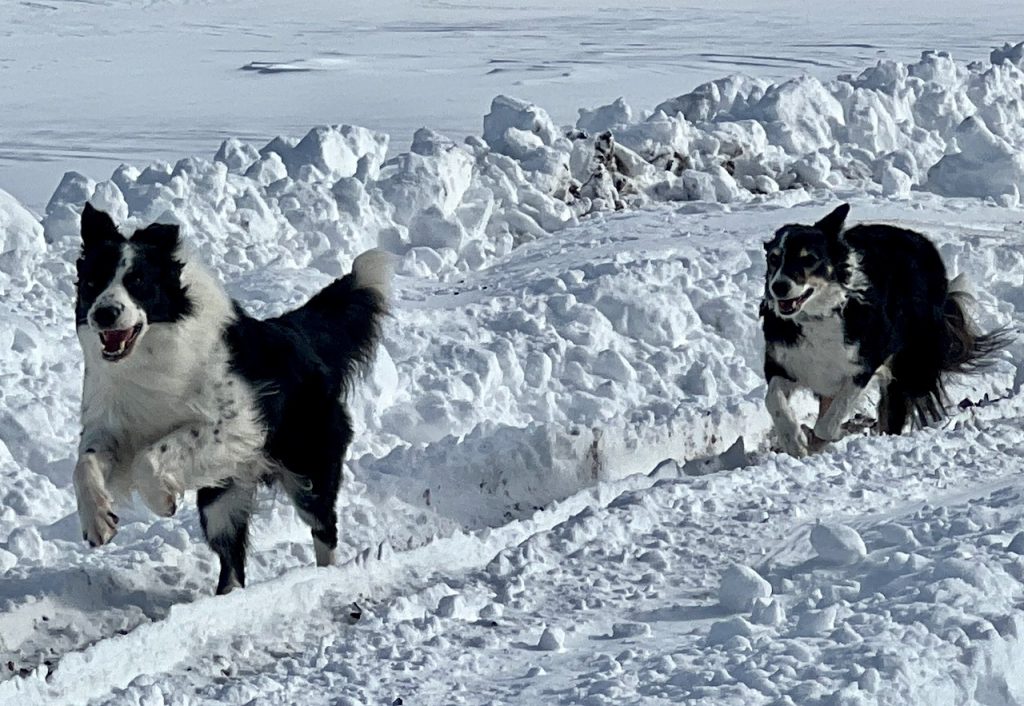
Skip’s feelings about the snow are obvious from the expression on his face. I’ve never known a dog who loved snow as much as Skip. They were tearing along a short, plowed section of a small park not far from us. There was no way you could walk it without snow shoes, so we lapped around a small area on Saturday morning, and the dogs exercised themselves. Saturday the high was in the mid 20’s, Sunday it was closer to zero, so walks off the farm will wait for warmer weather in the days to come.

I can’t tell you exactly how much snow we got last week, but somewhere around 20 inches in four days. The first storm had lots of warm, wet snow that stuck to the trees and branches, turning the world into a winter wonderland.

Lots of beautiful scenes in the snow, including with these screens we bought to distract from our ugly LP tank.


Here’s from last Tuesday, the first big storm that left us with 8-9 inches.

Needless to say, our six bird feeders are hopping. We have about 15-20 birds at our feeders at all times now. Chickadees, like the one below, Tufted Titmice, WB Nuthatches, Downy, Hairy, and Red-bellied Woodpeckers, Goldfinch (oh honey, why are you still here?!), Cardinals (who only showed up once the ground was snow covered), Juncos, House Sparrows, House Finches, Doves, and one rude Blue Jay.

I’m bummed there’s no sheep herding now (although nothing approaching Skip’s daily disappointment). The sheep below are standing in the snow from only the first storm, it’s more than twice as high now. Skip would be happy to work, but me and the sheep don’t share his enthusiasm.

Here’s to being enthusiastic about something in these dark, cold months! Tell us how “less is more” fits into your life–or how it doesn’t–with your dogs. More is good here!


from Tuuka's Tails https://tuukastails.com/how-dog-training-and-editing-are-the-same/
via Tuuka's Tails
How to feed RAW DIET and save money!!! (Save money with Freeze-Dried!!)


Alternative to more expensive forms of raw diet for dogs–we’ve had a lot of calls asking for an alternative to BARF raw patties so I’ve compiled info for you below! –and this whole month (February) its 50% off!!!!!!

We have been proponents and educators of raw feeding for almost 2 decades, and you can read our blogs to find out all about it and how it can benefit your dog.  We all enjoy the benefits of: real food, no gmo’s, no fillers, no artificial colors/preservatives, no smelly kibble poops, and the amazing ‘no shedding’ that raw is best known for.

Raw food is considered by many to be the most nutritious way to feed your pet. Pure, raw nutrition.

This highly nutritious limited-ingredient diet (LID) is a delicious combination of beef, beef liver, beef hearts, garbanzo beans, sweet potatoes, beef bone broth, kale, apples, blueberries,and pumpkin. Only the highest quality, fresh, whole ingredients for your pet, gently dried at low temperatures to preserve the nutritional value of each ingredient. This single-source animal protein diet contains only beef, so it’s great for pets with allergies or sensitivities.

This recipe is: 78% Beef and organs, 22% Wholesome fruits & vegetables and other nutrients. Exactly what over 4 decades of research has shown us!

Key Benefits:

  • Natural
  • High protein, antioxidant-rich formula
  • Grain-free
  • Gluten-free
  • GMO-free
  • Nutritionally-dense formula
  • Single-source animal protein – Great for pets with sensitivities
  • Natural source of DHA supports healthy brain development and function
  • Natural source of taurine to support heart and eye health
  • Balanced calcium and phosphorus for bone and tooth health
  • Contains Omega-3 and Omega-6 fatty acids for a healthy skin and coat
  • A good source of glucosamine to help maintain joint health
  • Contains prebiotics and probiotics to support a healthy digestive tract
  • Contains naturally occurring collagen derived from bone broth
  • Highly digestible to reduce stool volume
  • No added hormones or antibiotics
  • No added sugars or sweeteners
  • No corn, no wheat, no soy
  • No artificial colors, flavors or preservatives
  • Complete and balanced nutrition for dogs and cats
  • Developed by Veterinarians and Nutritionists
  • Formulated for all life stages
  • Made in the U.S.A.
  • Guaranteed Analysis:
    Crude Protein (min) 42.0%
    Crude Fat (min) 32.0%
    Crude Fiber (max) 5.0%
    Moisture (max) 6.0%
    Vitamin E (min) 75 IU/kg
    DHA*^ (min) 0.06%
    Omega-6 Fatty Acids*^ (min) 2.0%
    Omega-3 Fatty Acids*^ (min) 0.7%
    Glucosamine*^ (min) 500 mg/kg
    Taurine* (min) 0.1%
    Collagen*^ (min) 1.0%

Instead of regurgitating my blogs on the benefits of raw, I’m addressing the hundreds of clients we have been feeding a frozen raw form of raw food ALREADY and that has become a bit ‘cost-prohibitive’ to some of them, and many have called asking for an alternative.

After almost a year of researching and picking apart all alternatives, I found this to be a way of saving:

-A freeze-dried raw can be the best alternative if the ingredients are still bio-available and species-appropriate (paleo) for dogs. I had to find one that had the same healthy, bio-available nutrients as frozen raw.

-Not using a frozen food can mean $25 or more less a month in shipping due to no longer needing the Styrofoam box and dry ice, and the shipping cost for all of that weight. This company’s food costs less and lasts much longer!

-Freeze-dried offers peace of mind for those concerned about bacteria contaminants (which is very, very low in the deeply frozen version and I’ve never had an issue)—but some people are still scared by veterinarians and others that don’t understand the over 40 years of research behind Raw Diet for Dogs.

-Freeze Dried raw offers more moisture—70% is required by dogs (kibble only offers 10%–and dogs won’t always make up for that with extra drinking!) You’ll be adding moisture (broth, goats milk, or just plain water, let it sit, then offer it! YUM!

-Use “autoship” so you never run out, and save even more $$ per month.

-GET UP TO 25% OFF OF THE COST OF RAW FROZEN FOOD. (YOU FEED LESS!) IT COSTS LESS!

 SAVINGS I FOUND CHANGING TO RAW FROZEN TO FREEZE-DRIED—- MORE THAN 25%!!!!! LESS SHIPPING, NO FREEZING, AND PEACE OF MIND! EACH BAG COSTS LESS, AND I FEED LESS.

LEARN MORE HERE

AS A NEW CUSTOMER SAVE 10-20% OFF YOUR FIRST ORDER WITH CODE # (INTRO4U10/INTRO4U20)  on orders over $100. And don’t forget–ALL THIS MONTH ITS 50%% OF EVERYTHING!!!


from Tuuka's Tails https://tuukastails.com/how-to-feed-raw-diet-and-save-money-save-money-with-freeze-dried/
via Tuuka's Tails

6 Best Soft Food for Dogs with No Teeth

Dogs are more than just pets; they are members of our families. As such, we want to ensure that they are healthy and happy. However, some ...